Sustainability
A waste stream with nowhere to go, turned into a building material
Canadians use billions of beverage cartons every year. The paper gets recycled. The plastic and aluminium layer usually does not. That layer is our raw material.
What is PolyAl?
Polyethylene plus aluminium, bonded for life
A drink carton is roughly 75% paperboard, 20% polyethylene and 5% aluminium foil. The plastic keeps liquid in; the foil keeps oxygen and light out. Because the three layers are laminated together, the plastic and aluminium — PolyAl — have historically been landfilled or burned after the fibre is recovered.
That laminate is exactly what makes a good building panel: waterproof, dimensionally stable, chemically inert and dense. RETRAK presses it under heat into a homogeneous board with no additives, then profiles it into sheeting, cladding and coatings.
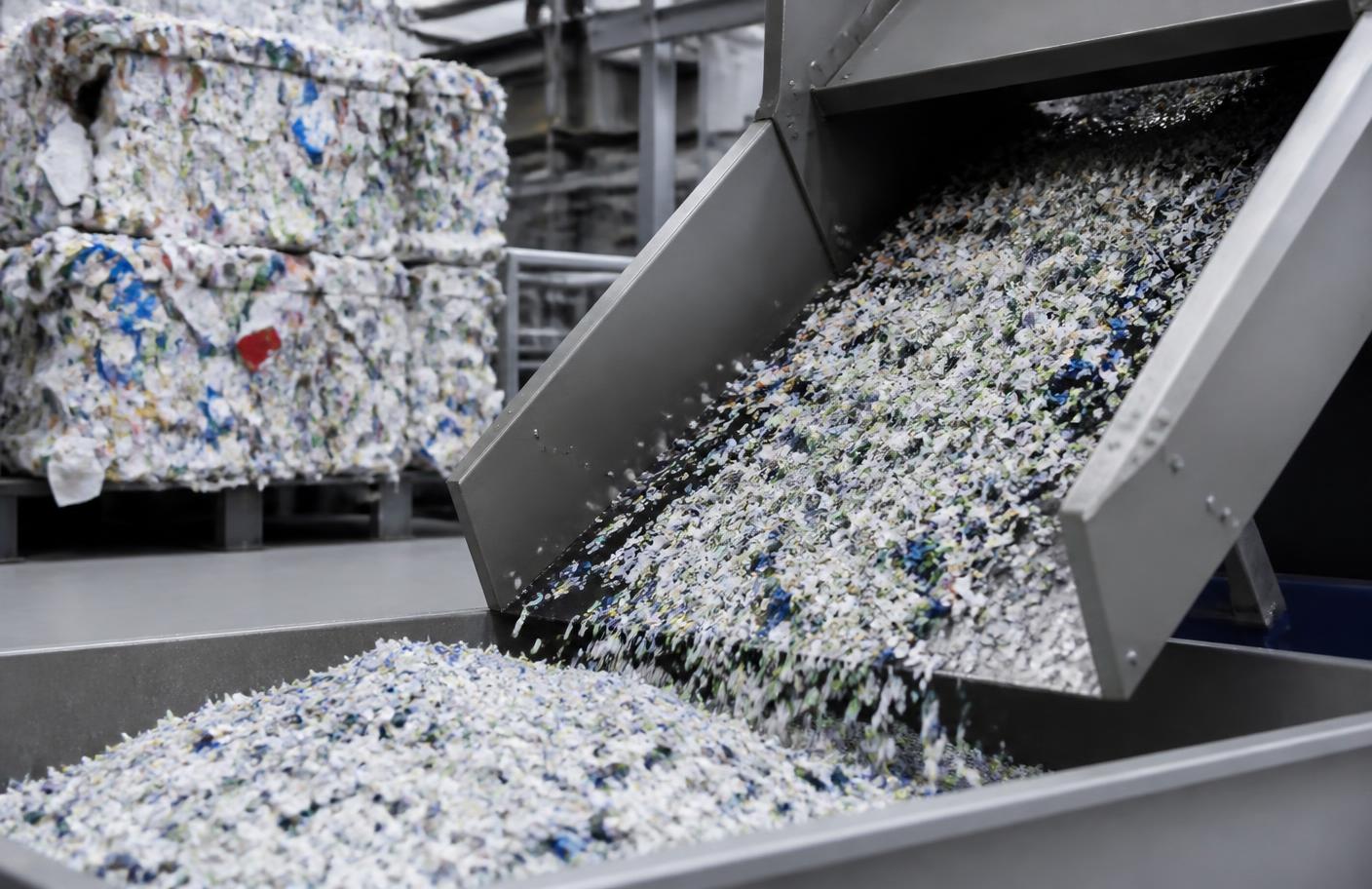
The Circular Process
From carton to cladding in six steps
- 01
Collection
Used beverage cartons are collected through municipal and commercial recycling streams.
- 02
Hydrapulping
Cartons are pulped in water. Paper fibre separates and is sold into tissue and packaging.
- 03
PolyAl recovery
The remaining polyethylene-aluminium laminate — PolyAl — is washed, dried and shredded.
- 04
Thermo-pressing
Flakes are heated and pressed into dense sheets. No solvents, no binders, no firing.
- 05
Profiling
Sheets are corrugated, cut to length and edge-finished to RETRAK profiles.
- 06
Second life
At end of service the panels are re-shredded and pressed again into new stock.
Environmental data
Measured, not claimed
- 1.2 million
- cartons of PolyAl diverted per production line each month (plant intake records)
- 330 °F
- peak process temperature — no firing, smelting or calcining step
- 0 L
- process water discharged; the wash stage runs closed loop
- 0 g/L
- added binders, solvents or VOC-bearing additives in the board
- 100%
- of production offcut re-shredded and returned to the press
Figures are plant-measured and self-declared. A third-party Environmental Product Declaration to ISO 14025 is scheduled for 2028; no life-cycle carbon figure is published until it is verified.
Future Goals
Where we're heading
- 2027Divert 15 million cartons annually across the Canadian production program.
- 2028Publish third-party Environmental Product Declarations for every product line.
- 2029Operate the Alberta line on 100% renewable electricity.
- 2030Launch a national take-back program for end-of-life RETRAK panels.
Recognitions & alliances
Independently validated, not self-declared
The PolyAl building material behind RETRAK was assessed against environmental, economic and social criteria and certified as an Efficient Solution by the Solar Impulse Foundation, recognised as an official UNESCO Green Citizens project.
Solar Impulse Foundation
Certified Efficient Solution
UNESCO Green Citizens
Official project — October 2021
One Young World
Global Ambassadors
The Climate Reality Project
Leadership Corps
Tetra Pak
Strategic feedstock alliance
Sustainable Development Goals
Where the impact lands
- SDG 9Industry, Innovation & Infrastructure
- SDG 11.6Sustainable cities — reduce waste impact
- SDG 13Climate Action
- SDG 15Life on Land